Orthopaedic Surgical Associates now offers online bill pay through the AdvancedMD Patient Billing Portal. You may access the portal here. First-time users will need to create an account using their e-mail address, Facebook, or Google accounts.
How to Make a Credit Card Payment
-
The account holder logs in to the portal and clicks the Pay My Bill or the Bills icon.

-
The account holder selects a Pay Now option.

-
The account holder clicks Make Payment. The Make Payment screen displays.

-
The account holder enters credit card and billing information and clicks Make Payment. If the payment is successfully submitted, the Payment Confirmation screen displays.

A payment confirmation email is emailed to the account holder with the transaction details for the charge.

Account-holders can check past payments from the Payment History tab.

Make a Payment with a Payment Plan
If the account holder has set up a payment plan with our office, they can view the following additional options:
- Payment Plan Balance – Total balance remaining in their payment plan.
- Monthly Payment Plan Amount – Amount due monthly.
They can opt to make payments towards their payment plan, or on charges outside of their payment plan.

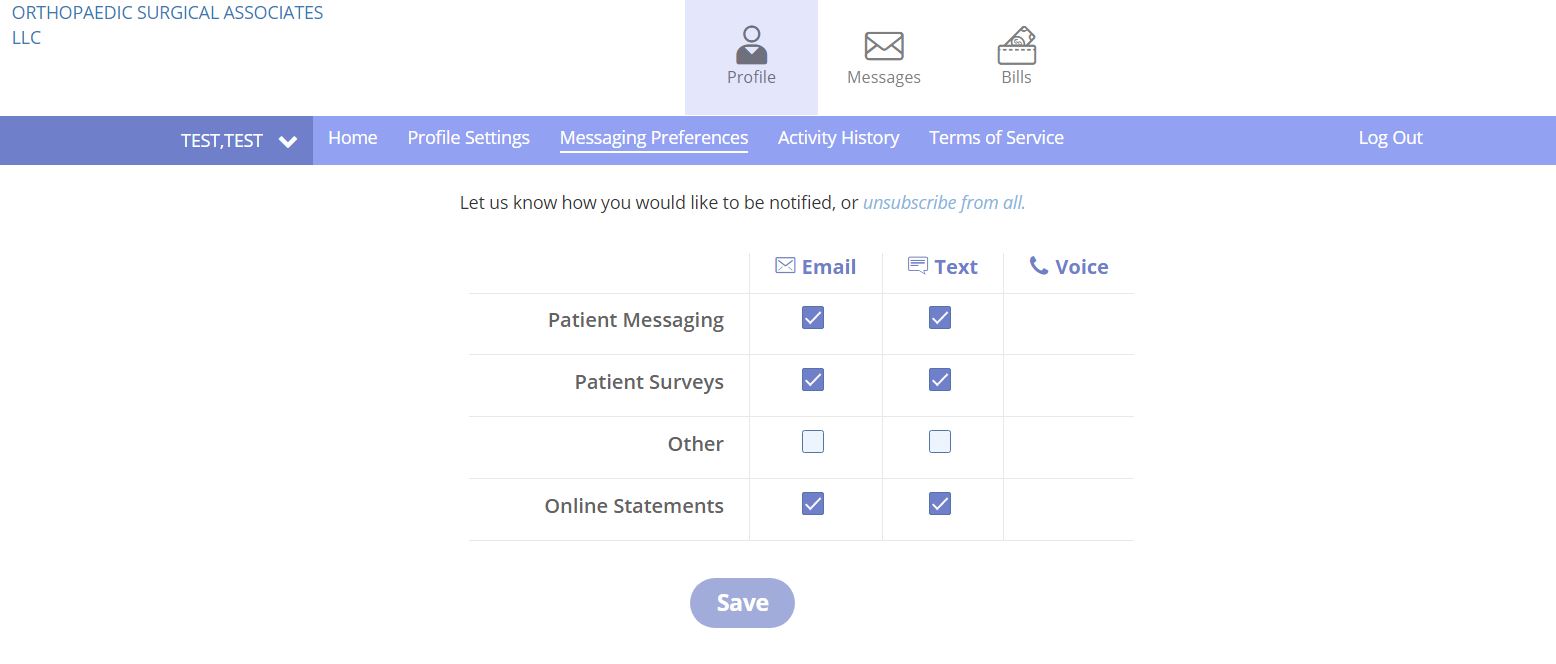
Patients may opt-out of electronic statements through the 'Messaging Preferences' tab
_______________________________________________________________________________________________
No Surprises Billing
Your Rights and Protections Against Surprise Medical Bills and Balance Billing.
When you get emergency care or get treated by an out-of-network provider at an in-network hospital or ambulatory surgical center, you are protected from surprise billing or balance billing.
What is “balance billing” (sometimes called “surprise billing”)?
When you see a doctor or other health care provider, you may owe certain out-of-pocket costs, such as a copayment, coinsurance, and /or a deductible. You may have other costs or have to pay the entire bill if you see a provider or visit a health are facility that isn’t in your health plan’s network.
“Out-of-network” describes providers and facilities that haven’t signed a contract with our health plan. Out-of-network providers may be permitted to bill you for the difference between what your plan agreed to pay, and the full amount of charges for that service. This is called “balance billing.” This amount is likely more that in-network costs for the same service and might not count toward your annual out-of- pocket limit.
“Surprise billing” is an unexpected balance bill. This can happen when you can’t control who is involved in our care—like when you have an emergency or when you schedule a visit at an in-network facility but are unexpectedly treated by an out-of-network provider.
Insurers are required to tell you, via their websites or on request, which providers, hospitals, and facilities are in their networks. Hospitals surgery centers, and providers must tell you which provider networks they participate in on their website or on request.
You are protected from balance billing for:
Emergency Services
If you have an emergency medical condition, mental health or substance use disorder condition and get emergency services from an out-of-network provider or facility, the most the provider or facility can bill you is your plan’s in-network cost-sharing amount (such as copayments and coinsurance). You can’t be balance billed for these emergency services. This includes care you receive in a hospital and in facilities that provide crisis services to people experiencing a mental health or substance use disorder emergency. You can’t be balanced billed for these emergency services, including services you may get after you’re in stable condition.
Certain services at an in-network hospital or ambulatory surgical center
When you get services from an in-network hospital or ambulatory surgical center, certain providers there may be out-of-network. In these cases, the most these providers may bill you is your plan’s in-network co-sharing amount.
You also are not required to get care out-of-network. You can choose a provider or facility in your plan’s network.
When can you be asked to waive your protections from balance billing.
Health care providers, including hospitals and air ambulance providers, can never require you to give up your protections from balance billing.
If you have coverage through a self-funded group health plan, in some limited situations, a provider can ask you to waive your balance billing protections, but you are never required to give your consent. Please contact your employer or health plan for more information.
When balance billing isn’t allowed, you also have the following protections:
You are only responsible for paying your share of the costs (like the copayment, coinsurance, and deductibles that you would pay if the provider or facility was in-network). Your health plan will pay out-of-network providers and facilities directly.
Your health plan generally must:
- Cover emergency services without requiring you to get approval for services in advance (prior authorization).
- Cover emergency services by out-of-network providers.
- Base what you owe the provider or facility (cost-sharing) on what it would pay an in-network provider or facility and show that amount in your explanation of benefits.
- Count any amount you pay for emergency services toward your deductible and out-of-pocket limit.
If you believe you have been wrongly billed, you may file a complaint with the federal government at https://www.cms.gov/nosurprises/consumers or by calling 1-800-985-3059. Visit https://www.cms.gov/nosurprises for more information about your rights under federal law.
Good Faith Estimates to the Uninsured /Self Pay
Good Faith Estimate of the expected charges – to new patients and continuing patients – who either don’t have insurance or are not planning to submit a claim for payment to their insurance carrier. The No Surprise Act has specific rules for what information the estimate must provide and the timeline for providing the estimate. Healthcare providers must provide self-insured patients and self-pay patients of their “right” to receive the Good Faith Estimate.
An uninsured patient is an individual who does not have benefits for an item or served under a group health plan; whereas a self-pay patient is an individual who has benefits under a group health plan but chooses not to have a claim submitted to their plan. The good faith estimate presented to an uninsured or self-pay patient must include services reasonable expected to be provided by the facility.
The Good Faith estimates do not apply if the patient is using Medicare, Medicaid, or another federal healthcare program (such as TRICARE). A Good Faith Estimate is not required for emergency services which, by definition, cannot be scheduled in advance.


